We Use CookiesWe use cookies to enhance the security, performance, functionality and for analytical and promotional activities. By continuing to browse this site you are agreeing to our privacy policy

10 Best Manometers 2026 in the United States

#1

Winner

10.0 score

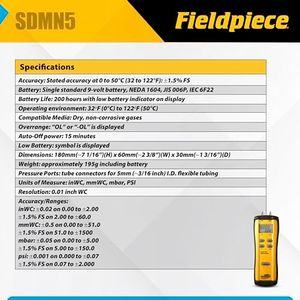
Fieldpiece Dual-Port Manometer - SDMN5
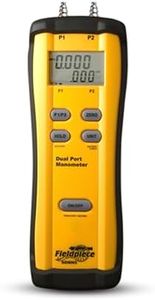
The Fieldpiece Dual-Port Manometer - SDMN5 is a compact and efficient tool designed primarily for HVAC professionals who need to measure duct pressures for air flow balancing. One standout feature is its dual-port design, which allows for simultaneous pressure measurements, making it convenient for technicians on the job. With a pressure range of -60.0" WC to 60.0" WC and a resolution of 0.01" WC, it offers accurate readings for static pressure, which is crucial in ensuring systems operate optimally.

Rating
10.0
Chosen by1,276
Type of Manometer
Durability and Build Quality
Additional Features

Most important from
637 reviews

Type of Manometer
This manometer works beautifully for reading manifold gas pressures and cuts down on time compared to single-port models.
Durability and Build Quality
Fieldpiece is known for quality tools, and this manometer allows for adjusting gas pressure and checking differential pressures efficiently.
Additional Features
Easy to use and straightforward, making it a reliable tool for technicians.
#2
9.7 score

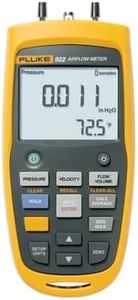
Fluke 922 Airflow Meter

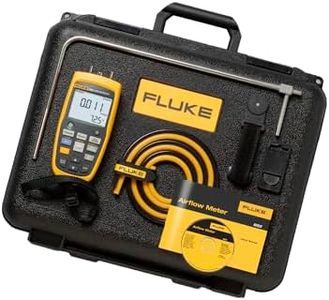
The Fluke 922 Airflow Micromanometer is designed primarily for HVAC professionals and building managers who need to measure pressure differences, airflow velocity, and volume accurately. It covers a useful pressure range with ±0.6 psi accuracy, which is solid for typical HVAC tasks. The bright 3.5-inch backlit display and color-coded hoses make reading measurements easier, even in dim environments.

Rating
9.7
Durability and Build Quality
Accuracy
Additional Features

Most important from
30 reviews

Durability and Build Quality
The airflow meter is remarkably easy to use and features a durable design suitable for harsh environments.
Accuracy
Accuracy is excellent for diagnostic and general HVAC tasks, consistently delivering dependable readings.
Additional Features
The bright, easy-to-read display and intuitive controls simplify measurements, even in challenging conditions.
#3
7.9 score

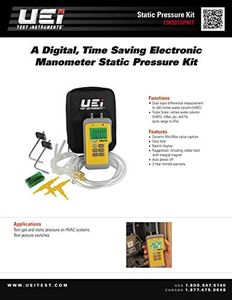
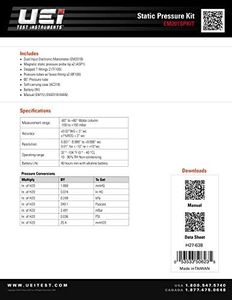
UEi Test Instruments Em201Spkit Static Pressure Kit
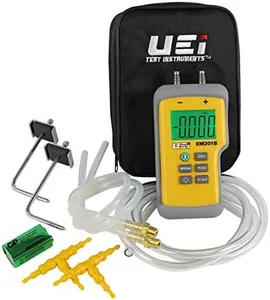
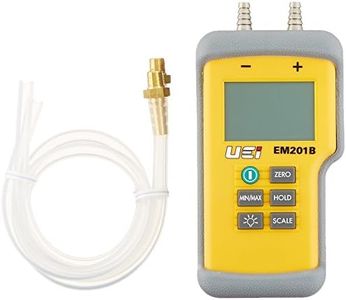
The UEi EM201SPKIT is a compact and versatile manometer designed primarily for measuring static pressure with a range up to 60 inches of water column. It supports dual input differential measurements, making it suitable for HVAC professionals or anyone needing to compare pressure between two points. The device offers three scales—inches water column, mBar, and PSI—providing flexibility depending on the preferred measurement unit.

Rating
7.9
Pressure Range
Accuracy
Durability and Build Quality

Most important from
405 reviews

Pressure Range
It accurately captures pressure differences, enabling effective assessment of HVAC components like filter pressure drops.
Accuracy
The manometer delivers solid build quality and reliable accuracy, making it a dependable tool for precise pressure measurements.
Durability and Build Quality
The manometer delivers solid build quality and reliable accuracy, making it a dependable tool for precise pressure measurements.
Additional Features
Its operation is intuitive and quick, with the ability to switch units effortlessly without consulting the manual.

Top 10 Best Manometers 2026 in the United States
#1

Winner

10.0  score

Fieldpiece Dual-Port Manometer - SDMN5

Pressure Range: -60.0" WC to 60.0" WC
Resolution: 0.01" WC
Type of Manometer: Dual-Port
Durability and Build Quality: Metal, Rubber
Additional Features: operator's manual

Chosen by 1276 this week

Fluke 922 Airflow Meter

Accuracy: ±0.6 psi
Type of Manometer: Airflow Micromanometer
Durability and Build Quality: sturdy plastic, 2-year warranty
Additional Features: auto frequency control, user ducts, bright display

UEi Test Instruments Em201Spkit Static Pressure Kit
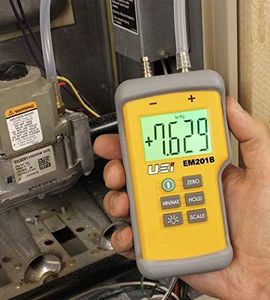
Pressure Range: up to 60 inches water column
Type of Manometer: dual input differential
Durability and Build Quality: rubber boot with built-in magnet
Additional Features: three scales, backlit, MIN/MAX, hold

Dwyer Series 475 Mark III Handheld Digital Manometer, 0-4.000"WC Range, 5 psig Maximum Pressure
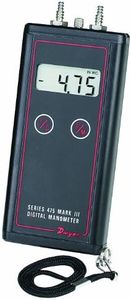
Pressure Range: 0-4 in water column, max 5 psig
Accuracy: ±0.5% full scale (60-78°F), ±1.5% else
Type of Manometer: Handheld digital manometer
Durability and Build Quality: Aluminum, rubber, lightweight 11.2 oz
Additional Features: FM-approved, dual buttons, tubing connections

Fluke 922/Kit Airflow Meter Kit

Pressure Range: differential and static readings
Accuracy: high accuracy
Resolution: 0.001 in H2O
Type of Manometer: Airflow Meter Kit
Additional Features: bright display; user-defined duct size; battery-powered
How do we rank products for you?

Our technology thoroughly searches through the online shopping world, reviewing hundreds of sites. We then process and analyze this information, updating in real-time to bring you the latest top-rated products. This way, you always get the best and most current options available.

headphones-stars

Buying Guide for the Best Manometers

Choosing the right manometer, a device used to measure pressure, is crucial for ensuring accurate readings and optimal performance in various applications. Whether you're using it for industrial purposes, HVAC systems, or laboratory experiments, understanding the key specifications will help you select the best manometer for your needs. Here are the essential specs to consider and how to navigate them.
Pressure RangeThe pressure range indicates the minimum and maximum pressure that the manometer can measure. This is important because using a manometer outside its specified range can lead to inaccurate readings or damage to the device. Pressure ranges are typically divided into low, medium, and high. Low-pressure manometers are suitable for applications like HVAC systems, medium-pressure ones are often used in industrial settings, and high-pressure manometers are used in more demanding environments like hydraulic systems. Choose a manometer with a pressure range that matches or slightly exceeds the maximum pressure you expect to measure.
AccuracyAccuracy refers to how close the manometer's readings are to the actual pressure. This is crucial for applications where precise measurements are necessary. Accuracy is usually expressed as a percentage of the full-scale reading. For example, a manometer with an accuracy of ±1% of full scale will have a smaller margin of error than one with ±2%. Higher accuracy is essential for laboratory and calibration purposes, while lower accuracy may be acceptable for general industrial use. Determine the level of precision required for your application to choose the appropriate accuracy.
ResolutionResolution is the smallest change in pressure that the manometer can detect. This is important for applications that require detecting minute changes in pressure. Higher resolution manometers can detect smaller changes, making them suitable for detailed analysis and fine-tuning processes. Lower resolution manometers are adequate for general monitoring where small changes are not critical. Consider the level of detail you need in your pressure measurements to select the right resolution.
Type of ManometerThere are several types of manometers, including digital, analog, and liquid column manometers. Digital manometers provide easy-to-read displays and often come with additional features like data logging. Analog manometers are simple and reliable, often used in rugged environments. Liquid column manometers, such as U-tube manometers, are highly accurate but can be more challenging to read and handle. Choose the type that best fits your application and user preference. For instance, digital manometers are great for quick and easy readings, while liquid column manometers are ideal for high-precision tasks.
Durability and Build QualityDurability and build quality determine how well the manometer can withstand the conditions of its intended use. This is important for ensuring longevity and reliability. Manometers used in harsh environments should be made of robust materials like stainless steel or reinforced plastics. For laboratory use, where conditions are controlled, build quality may be less of a concern. Assess the environment in which the manometer will be used and choose one with the appropriate durability and build quality to ensure it can handle the conditions.
Additional FeaturesAdditional features can enhance the functionality and ease of use of a manometer. These may include backlit displays for low-light conditions, data logging capabilities for tracking pressure over time, and connectivity options like Bluetooth or USB for transferring data to other devices. While these features are not essential, they can provide added convenience and efficiency. Consider which additional features would be beneficial for your specific application and choose a manometer that offers those enhancements.

FAQ